
Buell Motorcycles pushes the boundaries of performance-focused customization with a radical cafe racer interpretation of the Buell Super Cruiser.
Unveiled at a Daytona dealership event, the one-off machine features raw American V-twin power with stripped-down race aesthetics.
While it looks production-ready, Buell has confirmed it will remain a showcase build rather than a showroom offering.
Cafe Racer Transformation Of Buell Super Cruiser
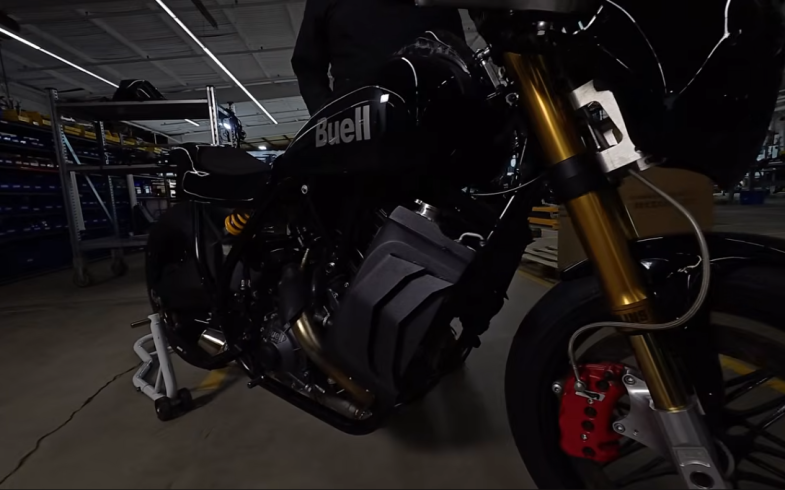
The concept retains the Super Cruiser's muscular foundation, including its 173bhp V-twin engine, frame, and swingarm. However, Buell changes the riding character entirely by shifting the ergonomics toward a traditional cafe racer stance.
The most noticeable change is the replacement of high-rise handlebars with low-mounted clubman bars. This forces the rider into a forward-leaning position.
Moreover, the adjustment increases front-end load and enhances steering feedback. With that, it delivers a sharper, more aggressive ride feel compared to the standard cruiser configuration.
The transformation is not merely cosmetic, but a deliberate attempt to merge cruiser power with sportbike precision.
Carbon Fiber And Race-Focused Components
Weight reduction and aerodynamic efficiency play a central role in the concept's design language. Extensive carbon fiber bodywork replaces heavier stock panels, sharpening the motorcycle's silhouette while improving its power-to-weight ratio.
Suspension duties are handled by race-spec components from Öhlins, tuned with reduced travel to prioritize handling precision over comfort.
The setup solidifies the bike's track-inspired identity, allowing it to corner with greater stability and responsiveness while sacrificing some road softness.
According to VisorDown, Buell also retains its signature perimeter-mounted front brake system, where the oversized rotor sits at the wheel's outer edge.
Additionally, this unconventional design reduces unsprung mass and improves braking rigidity. It contributes to more consistent stopping performance under aggressive riding conditions.
Chassis Geometry And Riding Position Changes
Beyond handlebars and bodywork, Buell refines the overall geometry to match the cafe racer vision. The lowered stance and forward-biased ergonomics shift weight distribution toward the front wheel, improving corner entry response.
The setup improves the motorcycle's agility, making it feel more planted during high-speed transitions.
Also, the riding position is intentionally uncompromising, prioritizing control and precision over long-distance comfort.
Cooling System Borrowed From Hammerhead 1190
To accommodate the redesigned front section, Buell reengineers the cooling system using a side-mounted radiator layout derived from the Buell Hammerhead 1190. This configuration allows the front end to remain compact while maintaining efficient airflow management.
The adaptation ensures that thermal performance is not sacrificed despite the tighter body packaging.
Why This Concept Will Not Enter Production
Despite its refined appearance and engineering depth, Buell has confirmed that the cafe racer will not move into production. The company views the project as an internal design exercise rather than a commercial prototype.
According to representatives, these builds exist primarily to explore styling directions and performance concepts.
As expected, the decision has disappointed some enthusiasts who see potential in a high-powered, lightweight cafe racer derived from the Super Cruiser platform.
Related Article: Nissan Z T-Top Revival Project Brings Classic Open-Air Design Back to Modern Sports Cars
Copyright @ MOTORTIMES, All rights reserved. Do not reproduce without permission.
TRENDING NOW
![[RUMOR] New Tesla Model Y Juniper Refresh Leak Claim to be Coming From Factory](https://d.motortimes.com/en/full/1725128/rumor-new-tesla-model-y-juniper-refresh-leak-claim-coming-factory.webp?w=234&h=132&f=2fe2bb429ec232f7e8f0d9597139c9a0)
Electric Vehicle Longevity Study Shows Tesla Among Top Brands For 250,000-Mile Lifespan
By Jose Enrico Coronel


Koenigsegg One:1 Hypercar Returns to Auction as Ultra-Rare €10M Collector's Icon
By Jose Enrico Coronel

Nissan Z T-Top Revival Project Brings Classic Open-Air Design Back to Modern Sports Cars
By Jose Enrico Coronel


GALLERIES


